Development of EU military cyber defence capability enters a new stage
Text: HDF Defence Staff Cyber and Information Operations Directorate | 16:08 June 18, 2026The documents of the PESCO Cyber and Information Domain Coordination Centre project – executed with Hungary’s participation – were recently handed over officially to the European External Action Service (EEAS) and the European Union Military Staff (EUMS) in Brussels.
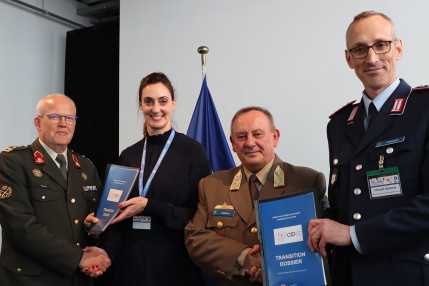
On June 10, 2026, Major General Hans Folmer, Chairman of Steering Board, PESCO Cyber and Information Domain Coordination Centre (CIDCC) and Colonel Christof Opolony, Director, PESCO CIDCC handed over the transition dossier of the project.
The official documents were received by Benedikta von Seherr-Thoß, Managing Director for Peace, Security and Defence at the European External Action Service, and by Major General Gábor Horváth, Deputy Director General and Chief of Staff, European Union Military Staff.
The Hungarian Defence Forces were represented at the event by Brigadier General Gábor Pozderka, Head of Cyber and Information Operations Directorate, HDF Defence Staff as the leader of the organization responsible for project execution.
According to plans, the EU Cyber Defence Coordination Centre (EUCDCC) will operate as the military “cyber centre” of the European Union, assuming a key role in generating a recognized picture of cyberspace. Within this framework, the member states will coordinate and collectively utilize their available resources so that they can avoid building parallel structures from the beginnings.
In her speech, Ms. von Seherr-Thoß thanked the founding nations (Germany, Hungary, France and the Netherlands) for their self-sacrificing work done in recent years, and emphasized that the Centre has outstanding significance to the European Union from both political and operative aspects. It will enhance Europe’s collective operational readiness and resilience, and contribute to achieving that the missions and operations receive targeted support in a field that is a key element in today’s security policy. For this reason, the latest event, the handover between the CIDCC and the European Union is an important milestone in the transition of the project into a permanent EU capability.
The recruitment of personnel with adequate expertise for the establishment of the centre has already begun, and the EU also counts on the experiences and knowledge of subject matter experts working in the project. In the coming weeks and months, the European External Action Service is going to provide all the conditions for the functioning, so that the CIDCC can start preparing structured analyses in support of the situational assessment of cyberspace.
“The findings of the PESCO project will now be directly incorporated into the establishment of the EUCDCC capability. The growth in staff numbers has already begun this month and is set to grow up [to full strength] in the next months” – said Major General Folmer.
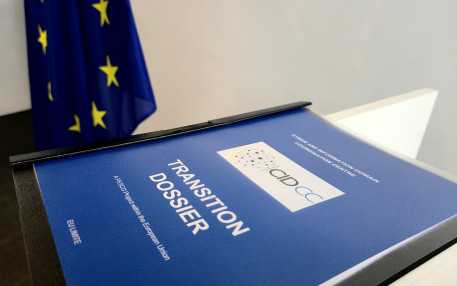
About the PESCO CIDCC project
The evolving geopolitical situation – especially Russia’s war of aggression against Ukraine – has made it clear that Europe’s security architecture needs comprehensive reinforcement. Besides the traditional operational domains – land, air and maritime –, cyberspace and information space have increasingly come into focus in recent years as a fourth theatre of war. Cyber attacks against organizations and critical infrastructure have by now become part of everyday life, while they characteristically do not reach the threshold of armed conflict.
In response to these developments, within the framework of the Permanent Structured Cooperation (PESCO) and in the interest of enabling the European Union to take efficient action in the digital space, in the fall of 2023 Germany, together with France, the Netherlands and Hungary, launched the Cyber and Information Domain Coordination Centre project which has since been operating in Brussels.
The aim of the initiative was to generate a central support capacity that is focused on the analysis of the cyber situation, and where the recognized pictures coming from cyberspace and information space are fused, and analyzed collectively. Following the conceptual phase of discussions among participating countries, a 11-strong multinational team of experts started working with Hungarian participation in Brussels.
Executed within the PESCO framework, the project has contributed to cyberspace becoming manageable and usable in practice as an independent operational domain. At the same time, it laid the foundation for the EU capability within the European External Action Service. The accumulated lessons learned in the project now serve as a starting point for building what may operate as the centre of cyberspace-related expertise in the future.
All in all, the PESCO project and the EU centre under construction significantly enhance the European Union’s capabilities of timely identification, analysis and assessment of ongoing processes and threats in cyberspace, and of efficient utilization of information in support of military operations and missions.


