V4: Joint Planning, Joint Thinking, Joint Battlegroup
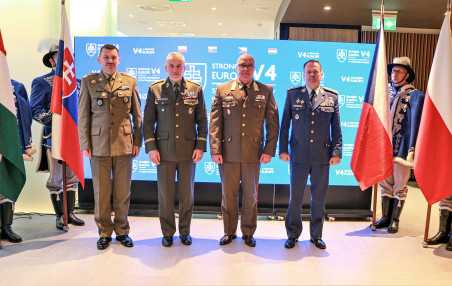
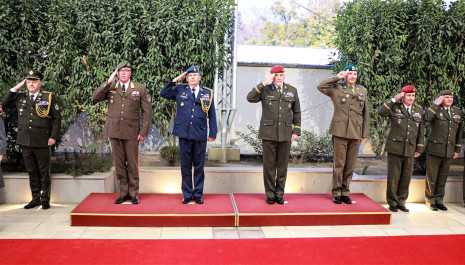
Text: defence.hu | Photo: mil.sk | 13:39 November 9, 2026The second meeting this year of the chiefs of defence of the Visegrád Four – including General Zsolt Sándor, Chief of HDF Defence Staff – was held in Bratislava. The parties reviewed the capabilities of the Polish, Czech, Slovak and Hungarian armed forces, preparations for the activities of the V4 EU Battlegroup due to be reactivated in 2028, and, in addition to evaluating this year’s exercises, also discussed the joint training events planned for the next two years.
The key topics of the meeting – including military development, the regional security situation and lessons learned from current armed conflicts – were discussed by General Miroslav Lorinc, Chief of Defence of Slovakia, Lieutenant General Miroslav Hlaváč, Chief of Defence of the Czech Republic, General Zsolt Sándor, Chief of HDF Defence Staff, and Major General Krysztof Zielski, Deputy Chief of the General Staff of the Polish Armed Forces.
With regard to the capabilities of national armed forces in relation to the use of new technologies, the focus has been on the deployment of drones and counter-drone capabilities, them, since they are playing an increasingly significant role in modern warfare. The national lessons learned of the countries participating in the meeting on this subject are relevant to both present and future warfare.
At the professional conference, Lieutenant General Miroslav Hlaváč reported that preparations for the V4 EU Battlegroup to be placed on standby in 2028 are proceeding according to plan. The Hungarian Defence Forces will contribute staff officers, engineering and medical capabilities to this formation – joint training for these components will begin early next year.
The presentation of General Miroslav Lorinc focused on the Slovak reserve system, which is extremely similar to the Hungarian one in terms of its structure, task system and success.
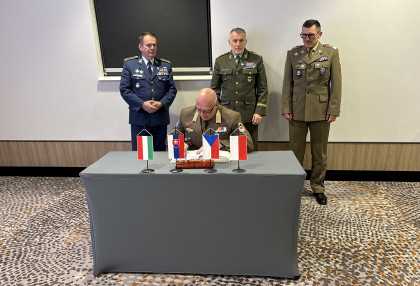
With regard to the joint exercises of the Visegrád Four, the parties agreed that it is not the number of such exercises that needs to be increased, but rather their intensity, in such a way that personnel can train in scenarios that most closely resemble real-world situations. There was agreement that the lessons learned from ongoing conflicts must be incorporated not only into training programmes as quickly as possible, but also into joint exercises. All military leaders reaffirmed the importance of the use of drones and counter-drone measures in this context as well.
During the meeting, the participants agreed to gradually reduce the number of V4 chiefs of defence meetings from the previous two per year to one. In place of the second one, they are to hold an expert-level discussion among the partner nations, where the focus will be on exchange of lessons learned. In addition to presenting the best and most effective professional practices, there will also be an opportunity to showcase new technologies.
Both days of the Bratislava meeting were characterised by an extremely open dialogue. The participants agreed that the meeting of the four countries’ chiefs of defence is a forum that must be continued, and that the V4’s combat ready armed forces and the close military cooperation among their countries form a solid foundation for a strong European Union and NATO.