Special Operations Capabilities in the Service of the Future
Text: Chief Warrant Officer Krisztina Végh | Photo: Franciska Veres archive | 15:56 December 8, 2025Within the framework of the Special Operations Conference 2030 series of professional events, the HDF Special Operations Command examined special operations capabilities of the future together with its international partners at the Görgey Artúr Barracks, Szentendre. In the first two days of the four-day forum, experts from Türkiye, Azerbaijan and North Macedonia also participated, thus strengthening cooperation in this field in the region.
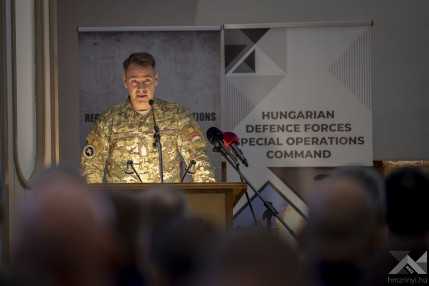
Thinking together, partnership and continuous development form the strongest basis for Hungarian and allied forces to be ready for future challenges – this is demonstrated by the Special Operations Conference, which was opened by Colonel Péter Simon, Commander, HDF Special Operations Command. In his speech, he emphasized that the role of the Special Operations Forces (SOF) community is expected to increase further in the following decade as the rapidly changing security environment, complex conflicts and technological development impose new demands on using SOF. He said that the 2030 special operations capabilities can be defined along three key fields: the increasing significance of rapid reaction and precision, the proliferation of modern technologies – including drones, artificial intelligence and cyber operation assets – and the preserved primacy of the human factor.
The colonel underlined that the future theatre of war will be both technology-driven and human-centred, as any innovation is only as efficient as those applying it are prepared and flexible. He added that these can be carried out only with strong international cooperation, because modern threats do not stop at borders. “I firmly believe that joint learning and confidence-building are the basis of future success.”
Colonel Ákos Tajti, Commander, HDF Transformation Command, greeted the participants as host of the event. In his speech, he organized his thoughts around the three pillars of capacity building, the analysis of lessons learned and adaptation. He pointed out that developing special operations capabilities is not only a technological investment but also the formation of such competencies that create real operational value. The systematic analysis of lessons learned – especially knowledge gained from decision-making situations on the battlefield – provides an essential foundation for future doctrinal and organizational developments. He underlined that the task of the HDF Transformation Command is to build bridges between past and future, lessons learned and innovation, and different HDF organizations and their international partners. The conference creates a professional dialogue that not only analyses current challenges but also shapes the future Hungarian special operations concept.
Participants agreed that creating flexible, integrated and modern special operations capabilities is a priority task of the following years, in which sharing the lessons learned on an international level, joint training and technological innovation continue to play decisive parts. At the professional panel discussions and workshops, they discussed the issues of training, operations planning and capability development suited to the 2030 operational environment.


