Who will Protect Europe?
Future of Continent’s Security in Focus
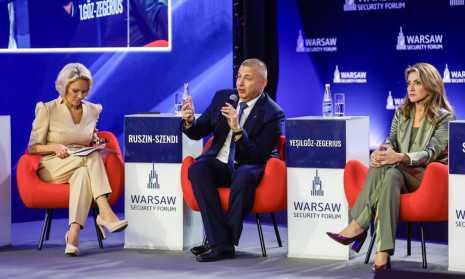
Text: Ministry of Defence | Photo: MoD | 14:09 October 13, 2026Europe must become capable of defending itself independently. To this end, it is not enough simply to rethink the continent’s defence strategy; it is essential to rebuild and modernise the European defence industry, said Defence Minister Romulusz-Ruszin Szendi at the Warsaw Security Forum held on Monday.
During a panel discussion titled “Can Europe defend itself?”, the minister emphasised, with regard to Ukraine, that creating peace is the top priority. As he put it, he had visited the Ukrainian front line and witnessed the horrors of the war first-hand.
“I visited the front line in Ukraine, where, as Chief of Defence, I travelled to several locations. What is happening there is devastating. People are risking their lives every day, while families are being torn apart and the war is claiming more and more lives.”
The minister also pointed out that, alongside with the war in Ukraine, particular attention must be paid to the stability of other regions in Europe. Security in the Western Balkans is of special importance to Hungary, and the country contributes to the stability of the region through the roles it has undertaken in the KFOR and EUFOR missions.
With regard to the development of European defence capabilities, Romulusz Ruszin-Szendi emphasised the importance of dual-use technologies. In his view, there is a need for developments that not only assist the defence forces in carrying out their tasks but also benefit the everyday lives of the civilian population, thereby enabling people to experience first-hand the practical benefits of defence developments.
The minister cited as an example the way in which the defence forces had helped to ensure the continued operation of the Paks Nuclear Power Plant during this summer’s exceptional drought. He also referred to the EOD tasks made necessary by the low water levels, as well as the military assistance provided in firefighting and in supplying water to the local population.
At the end of the panel discussion Romulusz Ruszin-Szendi emphasised the importance of strengthening the defence industry. He pointed out that foreign procurement offers only a partial solution in itself, as it is costly and often involves long delivery times. Europe therefore needs its own industrial and technological capacities to ensure its long-term security.
“We must strengthen the defence industry. We need capacities that enable us to meet both domestic and European demand, and which ensure the long-term availability of the necessary equipment.” He emphasised that the development of the defence industry is significant not only from a security policy perspective but also from an economic one, as expanding manufacturing capacities can create new jobs.
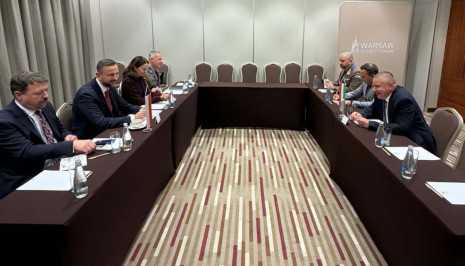
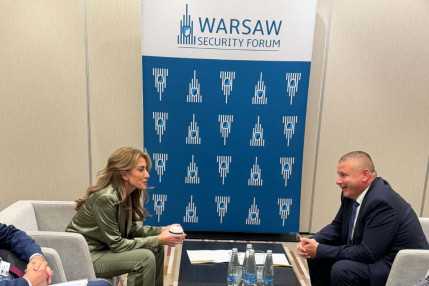
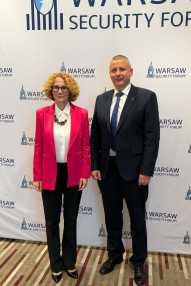
On the sidelines of the international forum, there was also an opportunity for bilateral meetings. Romulusz Ruszin-Szendi held discussions with Radmila Šekerinska, NATO’s Deputy Secretary General; Andrius Kubilius, the European Commissioner for Defence and Space; the Dutch Defence Minister, Dilan Yeşilgöz-Zegerius, and the Polish Defence Minister, Władysław Kosiniak-Kamysz.
During the meeting with NATO Deputy Secretary General Radmila Šekerinska, Romulusz Ruszin-Szendi discussed Hungary’s role within the Alliance, the development of the defence forces and the enhancement of military readiness. In relation to the war in Ukraine, the minister emphasised the importance of a diplomatic settlement and of improving Hungarian–Ukrainian relations.
The development of European defence capabilities, the potential of the Hungarian defence industry and military mobility were the focus of discussions with Andrius Kubilius, the European Commissioner for Defence and Space. The minister emphasised that Hungary supports the acceleration of European defence developments, but stressed that it is important for these to be carried out in line with NATO.
Romulusz Ruszin-Szendi discussed with Dutch Defence Minister Dilan Yeşilgöz-Zegerius the possibilities for further strengthening Hungarian–Dutch military-to-military relations. During his meeting with his Polish counterpart, Władysław Kosiniak-Kamysz, the discussion centred on developing military cooperation between the two countries, the lessons learnt from the war in Ukraine, and the future of the Visegrad cooperation.
If you are not at the table, you are on the menu
14:14 October 13, 2026


