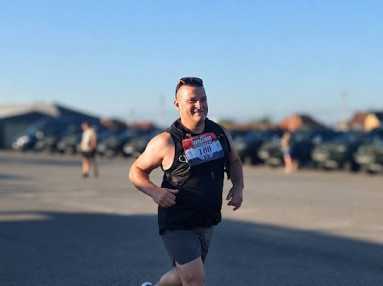
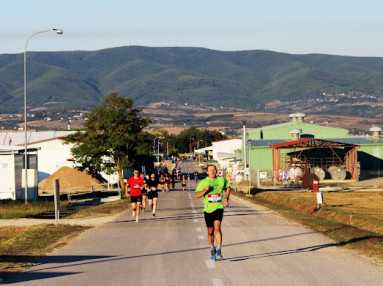
What began as a personal tribute to the memory of a mother grew into one of the largest sporting events of the KFOR mission: the “Hungarian Statehood Day Run.” The idea of Warrant Officer Zsolt Matolcsi eventually brought together more than one hundred soldiers in Kosovo, while the organiser himself completed the half-marathon distance on a challenging course featuring several climbs, finishing well within his target time. As his deployment draws to a close, we spoke with Warrant Officer Matolcsi about his personal motivation, the behind-the-scenes challenges of organising the event, preparing for the race alongside his military duties, and his experiences during the mission.
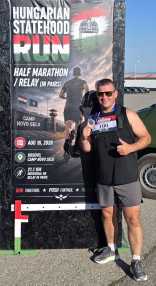
Completing a half marathon requires serious physical and mental preparation. Where exactly did the idea come from to honour your mother’s memory through a sporting achievement, and why did you choose the 21.1-kilometre distance for this personal commitment?
It all started with a very personal decision. Losing my mother last year was extremely difficult for me to process. In her memory, I wanted to do something that was not just about a single moment, but something that would require genuine effort, perseverance and preparation. For me, running is exactly that. A half marathon is also a distance that cannot be taken lightly. It is a serious physical and mental challenge, but one that can be completed with the right amount of work and preparation. Back in March, my only goal was to run the 21.1 kilometres in August, preferably in under two hours. Then I had the thought: why should I run alone? At first, I thought about inviting a few fellow runners. Then, in connection with the Hungarian Statehood Day celebrations, I thought about involving the Hungarian contingent. Finally, I realised that we could also invite personnel from the other nations serving alongside us. That is how a personal commitment eventually became an international sporting event. It started in memory of my mother, but by the end it had become a shared story for many more people.
Organising a mass sporting event in a military camp while carrying out mission duties is no small logistical challenge. How did your personal commitment turn into a race involving ten nations? What kind of support did you receive from the KFOR contingent leadership and from your fellow soldiers?
To be honest, at the beginning I never imagined that the initiative would grow to this extent. As I started organising it, new ideas kept coming. It required a tremendous amount of work, but every minute was worth it. Organising an event like this in a military camp is quite different from doing so in a civilian environment. The mission comes first, so everything had to be organised around our operational duties: the route, security arrangements, medical support, refreshments, technical requirements, and countless other small details. It meant a great deal to me that the contingent leadership supported the idea, and the help of my fellow soldiers was equally important. One person can come up with the idea for a race like this, but it cannot be made a reality alone. When I saw that, in the end, 114 soldiers from ten nations had lined up at the start, that was when I truly realised that something special had been created. Perhaps this is the best demonstration of the power of sport: we are soldiers from different nations, but on that starting line we were all there for the same 21.1 kilometres.
An event of this size requires continuous coordination right up to the starting moment and even afterwards. As the main organiser, how were you able to switch mentally into “race mode” before the start so that you could also achieve the time you had set for yourself?
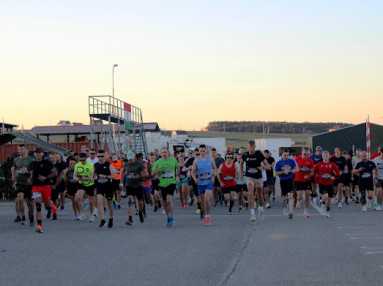
In the days leading up to the race, my mind was still working like an organiser’s: Is everything in place? Is everything working? Are the security arrangements in order? Is there anything else that needs to be taken care of?
Then, on the morning of the race, the moment came when I told myself: until now I have been the organiser; from this point on, I am a competitor. Once the race started, I tried to block everything else out and focus only on what was ahead of me. I wanted to finish in under two hours, and in the end my time was 1:48:26. Naturally, I am proud of that result, but on that day the clock was not the only thing that mattered to me.
When I crossed the finish line, I felt two things at the same time: that I had fulfilled the personal commitment I had made in memory of my mother, and that we had succeeded in creating something that, I believe, all of us will remember fondly.
The course included a number of climbs and long asphalt sections, making it physically demanding. How did you manage to balance your daily military duties with your preparation for the race?
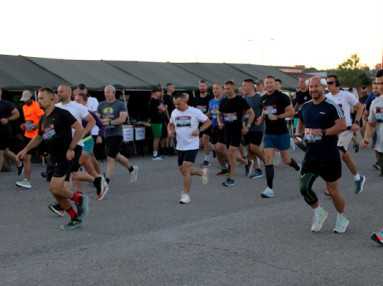
During a mission, military duties naturally take priority, so I had to build my training schedule around them. Quite often, I had to train at times when I would otherwise have preferred to rest. But perhaps that is precisely what made the whole experience even more valuable.
I also knew that I was not preparing for an easy course. Because of the climbs and the asphalt sections, I had to train deliberately, while at the same time making sure that I did not overstrain myself. There were easier days and more difficult ones, but throughout the preparation I had a very strong motivation. When you know exactly why you are doing something, it becomes much easier to put on your running shoes even when you do not particularly feel like it. Another major source of motivation was the HOME RUN challenge announced by the contingent at the beginning of the mission. The challenge required participants to complete 795 kilometres between Novo Selo and Debrecen from 23 March to 16 August 2026. I managed to complete 1,162 kilometres.
The 34th rotation of the Hungarian Defence Forces KFOR contingent is approaching the end of its deployment and you will soon be returning home. As an experienced service member with multiple overseas deployments, looking back on the past few months, what professional and personal experiences have you gained in Kosovo, and how was this deployment different from your previous ones?
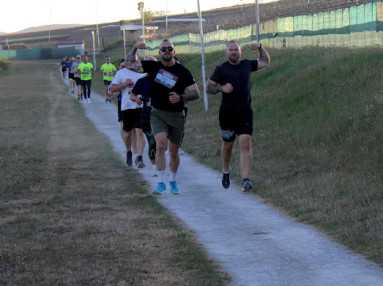
This is my ninth overseas deployment. In my opinion, every mission gives you something, both professionally and personally, but no two missions are ever the same. This mission will remain particularly memorable for me because, alongside my military duties, I had the opportunity to organise community initiatives that brought people together.
Perhaps the most important lesson is that the strength of a military community is not demonstrated solely by how we accomplish our tasks. It is also reflected in the way we support one another and in our ability to stand behind a common goal, regardless of nationality or rank.
As the time to return home approaches, naturally you start thinking more and more about home and your family. But when I look back on Kosovo and the 34th rotation, I am certain that the Hungarian Statehood Day Run will be one of my strongest memories. It started with a personal thought and ultimately became a shared achievement involving 114 people. It would be difficult to imagine a more beautiful way to bring this story to a close.