NATO Fuse 2026: Future Allied Battlefield Network Introduced in Riga
Text: HDF Defence Staff | Photo: HDF Defence Staff | 12:42 November 4, 2026The interoperability of communications and information systems (CIS), counter-drone assets and targeting capabilities used by NATO member states was tested in Riga and the nearby Ādaži military training area. Instead of being a traditional military exercise, the NATO Federated Unified Sensing and Effects was a “series of operational experiments” in the last days of October.
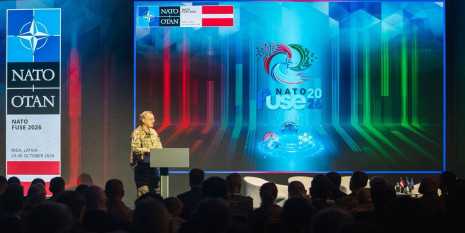
SACT delivering his opening speech at the NATO FUSE event
Besides the host, Latvian Defence Minister Raivis Melnis, contributors to the event included two NATO strategic commanders, General Alexus G. Grynkewich (Supreme Allied Commander Europe, SACEUR) and Admiral Pierre Vandier (Supreme Allied Commander Transformation, SACT), as well as Admiral Giuseppe Cavo Dragone, Chair of NATO Military Committee, Tarja Jaakola, NATO’s Assistant Secretary General for Defence Industry, Innovations and Armaments and Valdis Dombrovskis, Commissioner for Economy and Productivity, and for Implementation and Simplification at the European Commission.
The opening event was followed by a panel discussion, where NATO leaders highlighted the fact that the event, already organized for the fifth time, is given increasing emphasis in NATO’s capability development year after year. This year, it was attended by more than 700 guests and representatives of some 150 industrial branches – among them, military leaders of NATO member states, capability developers, tech companies, decision advisors and decision makers. On behalf of Hungary, Blue Planet New Energy Zrt. (BPNE) participated in the event as a technology partner of the Digital Backbone eXperimentation (DiBaX) 2026 experimentation environment.
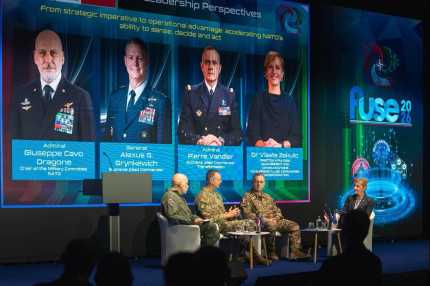
Panel discussion of NATO’s strategic commanders (CMC, SACEUR, SACT)
The Hungarian Defence Forces and the Chief of HDF Defence Staff were represented at the two-day professional display and the Distinguished Visitors’ Day of the exercise by Major General Zoltán Apáti, Director of Staff, HDF Defence Staff.
Why Latvia?
The choice of Latvia is no accident, as the Baltic region is one of the most sensitive areas on NATO’s eastern flank, where airspace violations, drone incidents and hybrid threats pose a real challenge every day. Besides, one of NATO’s innovation hubs also functions in Latvia. According to NATO, after the 2025 September drone incident in Polish airspace, it has become particularly timely to develop such systems that can quickly detect, identify and track small drones and at once are able to take appropriate and proportionate counteraction in cases like this, while not overwhelming the expensive and long-range air defence systems. In addition to presenting these assets and technologies, the exercise also demonstrated their operational deployment.

Elements of the NATO FUSE network exercises
Three main experimental programs
FUSE brings together three closely interconnected NATO initiatives, namely DiBaX, Layered Counter UAS Initiative (LCI-X) and the Next Generation Targeting (NTG) program, which seeks to find a solution to reducing “sensor to shooter” time (time elapsed from information gathering to decision making to achieving the desired effect). Furthermore, the experts also examined how the network and its elements used by the Allies can stay resilient against various jamming and cyber activities, and how the diverse sensors, jammers and interceptors of different nations can be fused into a unified, multi-layered counter-drone system.
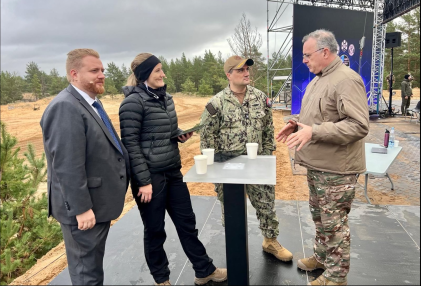
SACT with the narrators of NATO FUSE 2026


